
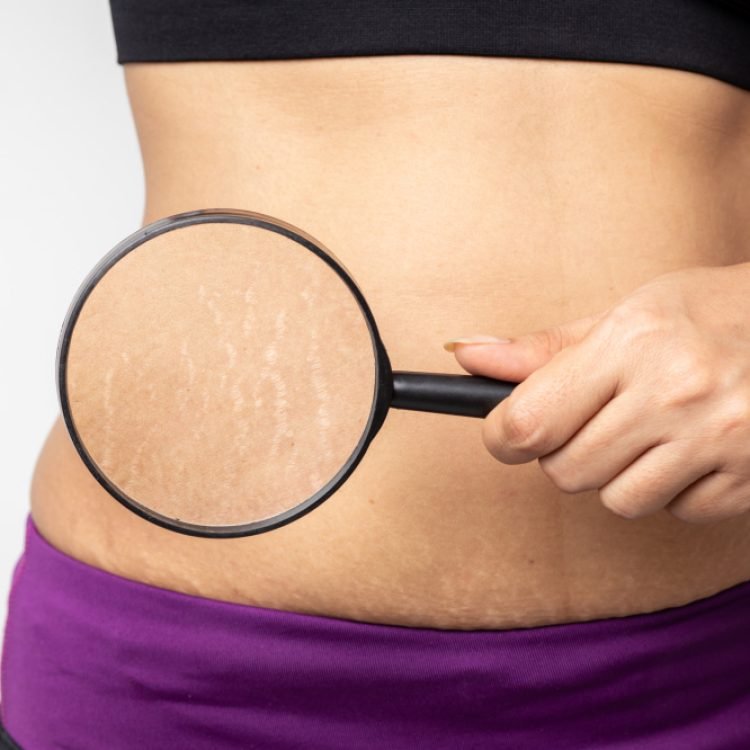
Do Stretch Marks Decrease Skin Elasticity?
Do stretch marks decrease skin elasticity? Within the mark itself, yes. Skin inside a stretch mark is measurably less firm and less elastic than the skin next to it. But the surrounding skin is unaffected, and the direction of cause runs the other way: disrupted elastic fibres produce the mark rather than the mark damaging your skin.
That reversal matters, because it changes what stretch marks tell you about the future.
On this page: The answer in three parts · Why the direction is backwards · What changes over time · What they predict · When they are a medical sign · The UK picture · What to ask · FAQs
Do stretch marks decrease skin elasticity everywhere, or only locally?
Only locally. The distinction is precise and worth setting out.
| Where | Is elasticity reduced? | What the evidence shows |
|---|---|---|
| Inside the stretch mark | Yes | A review of stretch mark management states the disrupted elastin network makes affected skin significantly less firm, less elastic and less deformable than normal skin |
| Skin immediately next to the mark | No | Adjacent skin is used as the comparison in these studies precisely because it behaves normally |
| Your skin in general | No | Having stretch marks in one area does not alter skin elsewhere on the body |
So someone with stretch marks on the abdomen has ordinary skin on the thighs, the arms and everywhere else. The change is confined to the lesions themselves.
The stretch marks concern page covers what they are and why they form.
Why the causation runs the other way
This is the part that most content gets backwards, and it changes how you should think about them.
Stretch marks form when skin is stretched faster than its connective tissue can adapt. NIH-published clinical information describes the process as disruption of dermal connective tissue, particularly collagen and elastin fibres, through mechanical stretching and hormonal influence, with breakdown of elastic tissue in the mid-dermis followed by reorganisation of collagen and fibrillin and thinning of the dermis.
Read that sequence carefully. The elastic fibre damage happens first. The visible mark is the result.
So a stretch mark is not something that then goes on to weaken your skin. It is the visible record of a place where the skin’s elastic network already gave way. The reduced elasticity and the mark are the same event, not cause and consequence.
The practical version: stretch marks are evidence of something that already happened, not a process that is still doing damage.
Stretch marks change, and the change is predictable
They pass through stages, which affects what you should expect and when.
New stretch marks are typically red, purple or pink, sometimes raised or slightly itchy. This stage is called striae rubrae. Over months, they fade towards pale, flat, silvery lines, called striae albae.
Published dermatology descriptions compare mature stretch marks to flattened dermal scars, with a thinned outer skin layer and densely packed collagen arranged in parallel lines. That comparison is useful. Like scars, they generally become less noticeable over time and do not disappear.
Two things follow. Judging a stretch mark in its red phase tells you little about how it will eventually look. And once it has faded to the pale stage, further spontaneous change is limited.
Stretch marks are extremely common. That same review notes striae affect a large majority of pregnant women, with published estimates spanning a wide range. They are a normal consequence of skin stretching rather than a sign that anything went wrong.
What stretch marks predict about future stretching
This is the question underneath the search, and it deserves a direct answer.
Having stretch marks tells you your skin stretched faster than it could adapt on at least one occasion. That is weak information about how your skin will behave next time, because the amount, speed and duration of stretching all differ between events, as does your age.
What it does not do is make future stretching worse. The existing marks are inert. They do not spread the damage, and they do not reduce the retraction capacity of the skin around them.
If your underlying question is whether your skin will retract after weight loss or pregnancy, stretch marks are a minor part of that picture. The guide to whether weight loss causes loose skin sets out what actually predicts retraction.
Worth being honest about the limits: no test predicts how any individual’s skin will respond to future stretching, and nobody can tell you in advance.
When stretch marks are a medical sign
Most stretch marks have an obvious explanation: pregnancy, a growth spurt, weight change, or muscle gain. Two situations do not, and they are worth knowing.
Corticosteroid use. Prolonged use of oral or topical corticosteroids is a recognised cause of striae. If marks appeared while using a steroid cream or taking steroid tablets, mention it to whoever prescribed them rather than stopping the medicine yourself.
Stretch marks without an obvious cause. Widespread or unusually wide purple striae appearing without pregnancy, growth or weight change can be a feature of Cushing’s syndrome. NHS information on Cushing’s syndrome describes a rare condition caused by too much of the hormone cortisol, most commonly from taking high doses of steroid medicines over a long period, and advises seeing a GP if you have symptoms, particularly if you are taking steroids.
Cushing’s syndrome is rare, and ordinary stretch marks are not a reason to suspect it. The point is that unexplained new striae, particularly alongside other changes, are a GP question rather than a cosmetic one.
Stretch marks in adolescents during growth spurts are common and expected, and rarely indicate anything beyond growing quickly.
Stretch marks and the UK system
Four points.
- Stretch marks are not a medical problem in themselves. Clinical sources describe them as causing no significant medical problem while acknowledging they can cause real distress. Both halves are true.
- Nothing cosmetic here is NHS-funded. Treatments aimed at improving the appearance of stretch marks are classed as cosmetic and are not routinely commissioned.
- Prevention creams are poorly evidenced. Published reviews describe the prevention of stretch marks using topical ointments and oils as debatable. That is a considerable industry resting on weak ground.
- New unexplained striae are a different conversation. If they appeared without pregnancy, growth or weight change, or while using steroids, that warrants a GP appointment.
Because anything cosmetic would be self-funded, there is no clinical deadline and no reason to hurry a decision. For detail on self-funded options and what each involves, that sits on Revitalize in Turkey rather than here.
What to ask your doctor
Worth asking a GMC-registered doctor:
- Do these look like ordinary stretch marks, or is there anything unusual about the pattern?
- Could any medicine I take, including steroid creams or inhalers, be contributing?
- Did these appear without an explanation that makes sense to you?
- Are they in the early red stage or the mature pale stage?
- Is there anything here you would want to investigate rather than treat as cosmetic?
- Is any itching or irritation worth treating in its own right?
Frequently asked questions
Does having stretch marks mean my skin is less elastic overall?
No. Reduced elasticity is confined to the stretch marks themselves, where the elastin network has been disrupted. Skin adjacent to the marks behaves normally, which is why researchers use it as the comparison. Stretch marks in one area say nothing about skin elsewhere on your body.
Do stretch marks get worse over time?
Generally the opposite. New marks are typically red or purple and become paler and flatter over months as they mature. That fading is the usual course. Established pale marks change little afterwards, and existing marks do not spread or worsen the skin around them.
Will stretch marks make loose skin more likely after weight loss?
Not directly. Existing marks do not reduce the retraction capacity of surrounding skin. Whether skin retracts after weight loss depends mainly on the amount lost, your age, how long the skin was stretched and genetics, rather than on whether you already have stretch marks.
Can stretch marks be a sign of something medical?
Sometimes. Prolonged use of oral or topical corticosteroids is a recognised cause. Widespread purple striae appearing without pregnancy, growth or weight change can feature in Cushing’s syndrome, which is rare. Unexplained new stretch marks warrant a GP appointment, particularly alongside other changes.
Do creams prevent stretch marks?
The evidence is weak. Published dermatology reviews describe prevention using topical ointments and oils as debatable rather than established. Products are widely sold on this promise, and the research supporting it does not match the confidence of the marketing.
Are stretch marks scars?
They are frequently compared to them. Mature stretch marks have been described in dermatology literature as resembling flattened dermal scars, with thinned outer skin and collagen arranged in parallel lines. Like scars, they typically become less noticeable over time without disappearing completely.