Does an Apron Belly Improve on Its Own?
Does an apron belly improve on its own? Partly, and it depends what it is made of. The fat component can reduce with changes in body composition. The stretched skin component does not retract fully once it has been significantly stretched, particularly after pregnancy, large weight loss or with age.
Time helps most in the first months after birth. After that, the picture changes considerably.
On this page: What it is made of · When it does improve · When it does not · The infection nobody mentions · When the NHS does fund treatment · What to ask · FAQs
Does an apron belly improve on its own, or only partly?
Only partly, and which part depends on you.
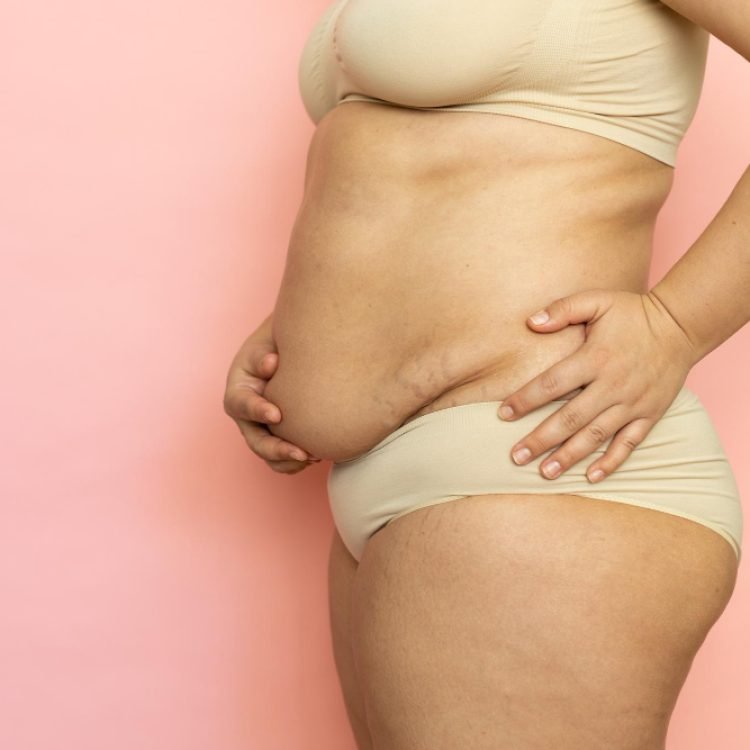
An apron belly, known clinically as a pannus or panniculus, is a fold of abdominal tissue that hangs over the lower abdomen. It is made of three things in varying proportions.
| Component | Does it improve on its own? | What influences it |
|---|---|---|
| Fluid and uterine changes after birth | Yes, substantially, over weeks to months | Time. This resolves without intervention |
| Subcutaneous fat | Yes, alongside overall body composition | Body composition, which is partly influenceable |
| Stretched skin and connective tissue | Generally not, once significantly stretched | Age, how far it stretched, how long for |
Subcutaneous fat is the fat layer sitting directly under the skin.
The proportions matter more than the size. Two people with apron bellies that look similar can have completely different outcomes over the following year, because one is mostly fluid and fat and the other is mostly skin.
The apron belly concern page covers the anatomy and causes in more detail.
When it genuinely does improve
Two situations where waiting is reasonable rather than passive.
The first year after birth. The abdominal wall contracts substantially in the months after delivery as the uterus returns towards its former size and fluid levels normalise. Most of that happens without any intervention, and judging your abdomen at six weeks tells you very little about where it will settle. If abdominal muscle separation is also part of the picture, the guide to whether ab muscle separation gets better over time covers that timeline.
Where the fold is mostly fat. Because fat is metabolically active, it reduces as overall body fat reduces. What you cannot do is direct that reduction to your abdomen specifically, which is why targeted approaches disappoint.
In both cases the improvement is real. The limit is that neither addresses stretched skin.
When it does not improve on its own
Skin that has been stretched significantly for a long time does not fully retract. That is a mechanical limit rather than a failure of effort.
Three factors make incomplete retraction more likely: greater stretch, longer duration, and older age at the time the volume reduces. Skin elasticity declines with age and with cumulative sun exposure, so the same amount of change produces different results at 30 and at 55.
This creates an outcome that surprises people. Losing a substantial amount of weight can leave the apron looking more defined rather than less, because the fat inside it has gone while the skin covering it has not tightened to match. That is not something you did wrong, and it is not a reason to reverse a weight change made for health reasons.
There is no cream, wrap, supplement, belt or exercise with evidence for retracting stretched abdominal skin. Anything sold on that promise is claiming something not demonstrated.
The problem that goes unmentioned
This is the most useful section on the page, and it is the one that gets left out of appearance-focused content.
The skin beneath an abdominal fold is warm, moist and rubs against itself. That environment commonly produces intertrigo, an inflammatory rash in the skin fold that can become infected with yeast or bacteria.
Signs to look for: redness or rawness under the fold, soreness or itching, an unpleasant smell, weeping or broken skin, or a rash that keeps returning after clearing.
Intertrigo is treatable, common, and not something to be embarrassed about raising. A GP or pharmacist can help, and treating it early prevents skin breakdown.
There is a second reason to take it to a GP rather than managing it privately, and almost nobody knows it. Recurrent intertrigo documented in your medical record is the single criterion most often named in NHS funding policies for removing an abdominal apron. Treating it quietly at home leaves no record, and no record means no evidence if you ever apply.
Separately, a firm discrete lump within or near the fold, or a bulge that will not flatten when you lie down, may be a hernia rather than fat or skin. That warrants a GP appointment, and sudden severe pain with a bulge that will not reduce needs urgent attention.
When the NHS does fund treatment
This is unusual. Most appearance concerns are never NHS-funded. An abdominal apron sometimes is, on functional rather than cosmetic grounds, and knowing the criteria changes what you should be doing now.
Guidance published by NHS Hertfordshire and West Essex states these procedures should not be commissioned for cosmetic reasons, and sets out functional criteria including an abdominal apron hanging at or below the level of the pubic bone together with severe difficulty with daily activities, or recurrent intertrigo beneath the skin fold, panniculitis or skin ulceration.
Policy also distinguishes between two operations. NHS commissioning guidance from Cheshire and Merseyside describes removal of the overhanging fold as a largely functional operation with little improvement in abdominal appearance, and the more extensive procedure as widely considered cosmetic rather than functional. Where funding is granted, it is usually for the first.
Criteria vary considerably between integrated care boards and between the four UK nations. NHS Wales policy requires a stable body mass index within a defined range and weight loss maintained for at least two years, alongside severe functional problems. English policies commonly set their own thresholds and require documented treatment over a minimum period.
Three practical points follow.
- The record is the application. GP visits, antifungal or antibiotic courses, dermatology or tissue viability referrals and clinical photographs all become evidence.
- Weight stability matters as much as weight. Most policies require a sustained stable period rather than a number reached recently.
- Ask your GP what your local policy says. Do not assume the position in one area applies in another.
Distress about appearance alone rarely meets these criteria, which is worth knowing before you apply rather than after. For detail on self-funded options and what each involves, that sits on Revitalize in Turkey rather than here.
What to ask your doctor
Worth asking a GMC-registered doctor:
- How much of this looks like skin rather than fat, in your assessment?
- Is what I have under the fold intertrigo, and should it be recorded as recurrent?
- Is there anything here that could be a hernia rather than skin or fat?
- What does my local integrated care board’s policy actually require?
- Is my weight stable enough, and for long enough, to matter for that policy?
- If I do not meet the criteria, is there anything else worth doing for the skin irritation?
Frequently asked questions
How long does an apron belly take to go down after pregnancy?
Most spontaneous improvement happens in the months following birth, as the uterus contracts and fluid levels normalise. Judging your abdomen at six weeks tells you little about where it will settle. Skin that stretched significantly may not fully retract, and that component does not follow the same timeline.
Can exercise get rid of an apron belly?
Exercise can reduce the fat component alongside overall body composition, but it cannot target the abdomen specifically and does not retract stretched skin. Someone whose apron is mostly skin will see limited change from exercise alone. That is a mechanical limit rather than a sign of insufficient effort.
Does an apron belly go away with weight loss?
The fat within it reduces, but the skin does not necessarily tighten to match. Losing a substantial amount of weight can leave the fold looking more defined rather than smaller, particularly at older ages or after rapid loss. This is common and is not a reason to reverse a weight change made for health reasons.
Is the rash under my apron belly serious?
Intertrigo, an inflammatory rash in skin folds, is common where skin rubs and stays moist, and can become infected. It is treatable and worth raising with a GP or pharmacist rather than managing quietly. Broken or weeping skin, spreading redness, or a rash that keeps returning should be seen.
Can you get an apron belly removed on the NHS?
Sometimes, on functional rather than cosmetic grounds. Policies typically require the fold to cause severe functional difficulty or recurrent skin problems such as intertrigo or ulceration, alongside stable weight over a sustained period. Criteria vary considerably between integrated care boards and the four UK nations, so ask your GP locally.
Does an apron belly mean something is medically wrong?
Not in itself. It is a description of where tissue sits rather than a diagnosis. What can be medically significant is what develops within the fold, such as recurrent skin infection or ulceration, or a hernia. Those are worth assessing, and both are treatable.