Do Hormones Cause Female Hair Thinning?
Do hormones cause female hair thinning? Less clearly than the name suggests. The common permanent type was called female androgenetic alopecia, but dermatologists now prefer female pattern hair loss precisely because the hormonal relationship is uncertain in women. Most affected women do not have raised androgen levels.
Meanwhile the type most clearly triggered by hormonal events is the temporary one. The story runs roughly backwards.
On this page: Why the name changed · Two kinds of thinning · What the oestrogen evidence shows · Which tests are worth having · The type that needs urgency · The UK picture · What to ask · FAQs
Do hormones cause female hair thinning, or was the name misleading?
The name changed because the evidence did not support it.
DermNet’s clinical summary of female pattern hair loss states that because of the uncertain relationship with androgens, the term female pattern hair loss is preferred to female androgenetic alopecia.
A review of female pattern hair loss puts it more bluntly, stating that the condition is generally not associated with elevated androgens. Where a hormonal abnormality is present, the review notes polycystic ovary syndrome as the most common one, usually alongside other signs such as excess hair growth, acne or irregular periods.
So androgens are involved in the mechanism, through follicles becoming progressively smaller, but the levels in your blood are usually normal. Sensitivity of the follicle appears to matter more than how much hormone is circulating.
That is the same pattern seen in acne, covered in the guide to whether hormones cause acne.
The female hair thinning concern page covers the anatomy and causes in more depth.
Two kinds of thinning, and only one is permanent
Separating these is the most useful thing on this page, because the outlook is completely different.
| Female pattern hair loss | Telogen effluvium | |
|---|---|---|
| How it starts | Gradual, over years | Sudden, usually two to four months after a trigger |
| Where | Widening parting, thinning at the top of the scalp | Diffuse across the whole scalp |
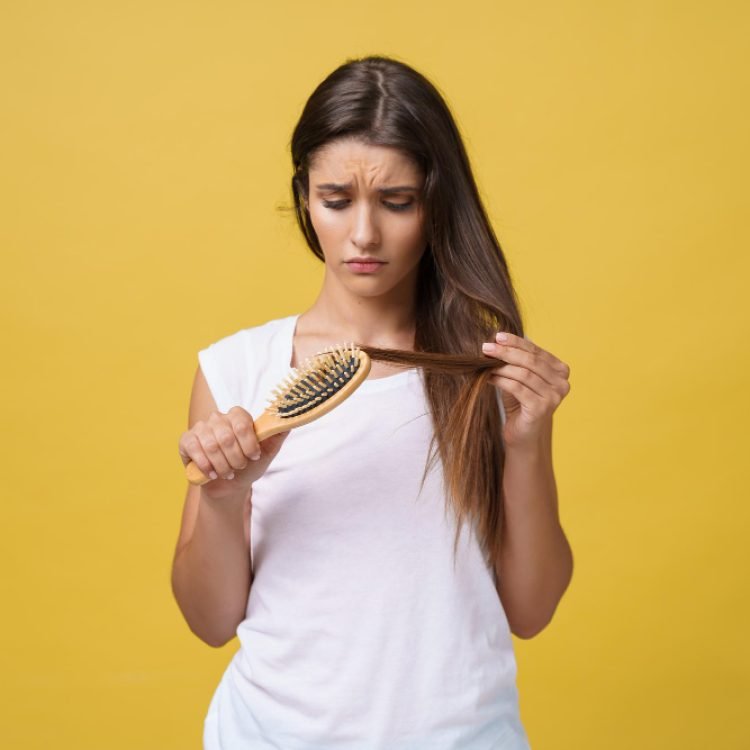
| What you notice | Hair looks thinner, ponytail smaller | Handfuls of hair coming out |
| Hormone link | Uncertain. Levels usually normal | Clearer. Childbirth and thyroid disease are recognised triggers |
| Does it recover? | Not spontaneously | Usually yes, once the trigger has passed |
Telogen effluvium means an unusually large share of hairs shifting into their resting phase at once, then shedding together.
DermNet notes it is normal to lose up to 50 to 100 hairs a day, so shedding alone is not the signal. A change from your own normal is.
One complication worth knowing: the two overlap. Published clinical information describes pattern hair loss in women being unmasked by an episode of shedding, so a postpartum or post-illness shed can reveal thinning that was already developing quietly.
The oestrogen evidence points both ways
Being straight about this matters, because menopause is where most people expect a clear answer.
DermNet states the role of oestrogen is uncertain. Pattern hair loss is more common after menopause, which suggests oestrogen may stimulate hair growth. But laboratory work has also suggested oestrogen may suppress it.
Those two observations do not sit comfortably together, and nobody has resolved them. Anyone telling you confidently that falling oestrogen causes your hair loss is going further than the evidence.
What is not in question is that thinning becomes more common with age. DermNet reports around 40% of women show signs of hair loss by age 50, and fewer than 45% reach 80 with a full head of hair. Common does not mean untreatable, and it does not mean you have to accept it.
Which tests are actually worth having
This is where the hormone question becomes practical, and the answer is counterintuitive.
There is no blood test that diagnoses female pattern hair loss. Because androgen levels are usually normal, a hormone panel will typically come back unremarkable and tell you nothing useful.
But there are tests worth having, and they look for the reversible causes rather than the permanent one.
Iron stores. A study of women with telogen effluvium found low serum ferritin significantly associated with the condition, and concluded ferritin may be a useful marker in women presenting with diffuse shedding. Ferritin is a measure of stored iron.
Thyroid function. Both underactive and overactive thyroid are recognised causes of diffuse shedding, and both are treatable.
Androgens, but only with other signs. Testing is appropriate where there are additional features suggesting excess androgens, such as irregular periods, excess body hair or adult acne. Without those, it rarely changes anything.
So the useful request at a GP appointment is not “test my hormones”. It is “please check my ferritin and thyroid, and tell me whether anything about my pattern suggests we should look further”.
The one type that is time-critical
Most female hair thinning is not urgent. One form is, and it is under-recognised.
Frontal fibrosing alopecia is a scarring hair loss affecting mainly postmenopausal women, in which the frontal hairline recedes and eyebrows are often lost. It is included in the differential diagnoses that clinical reviews advise distinguishing from pattern hair loss.
The reason it matters is that scarring destroys the follicle. Treatment aims to halt progression rather than restore what has gone, so the window for acting is while it is still advancing.
Worth raising promptly with a GP: a hairline that is receding rather than a parting widening, loss of eyebrows alongside scalp thinning, or scalp redness, scaling, itching, burning or tenderness. Patchy round bald areas appearing quickly are also a different condition and warrant assessment.
None of that is a diagnosis, and this guide cannot tell you which you have. It is a list of things worth mentioning rather than watching.
Female hair thinning and the NHS
The UK position has a split in it that catches people out.
- The NHS generally does not treat pattern hair loss. It is usually regarded as cosmetic, and treatments for it are not routinely funded.
- But the underlying causes should be investigated. Diffuse shedding warrants looking for iron deficiency, thyroid disease and other reversible causes. That part is ordinary NHS care, and it is what you are asking for.
- Referral happens for specific reasons. Suspected scarring alopecia, patchy loss, or thinning with signs of excess androgens are the situations most likely to reach a dermatologist.
- Wigs are available on the NHS in some circumstances. Eligibility varies by area and situation, so ask rather than assume.
Go in with a timeline. When the change began, whether it followed childbirth, illness, surgery, a major stressor or a medication change, and whether it is shedding or gradual thinning. That distinction is what a clinician needs and it is easy to lose under appointment pressure.
For detail on self-funded options and what each involves, that sits on Revitalize in Turkey rather than here.
What to ask your doctor
Worth asking a GMC-registered doctor:
- Does this look like gradual pattern thinning or a shedding episode?
- Could you check my ferritin and thyroid function?
- Is there anything about my hairline, eyebrows or scalp that concerns you?
- Do I have any other signs that would justify checking androgen levels?
- Could any medication I take be contributing?
- Is there any reason to refer me to a dermatologist?
Frequently asked questions
Is female hair thinning caused by hormones?
Only loosely, for the common permanent type. Dermatology sources prefer the term female pattern hair loss to female androgenetic alopecia precisely because the androgen relationship is uncertain in women, and most affected women have normal androgen levels. Hormonal events more clearly trigger the temporary shedding type instead.
Will a hormone blood test show why my hair is thinning?
Usually not. No blood test diagnoses female pattern hair loss, and androgen levels are typically normal. Testing is more useful for finding reversible causes, particularly iron stores and thyroid function. Androgen testing is generally reserved for women with other signs such as irregular periods or excess hair growth.
Does menopause cause hair thinning?
Thinning becomes more common after menopause, but the mechanism is unresolved. DermNet notes the role of oestrogen is uncertain, since the timing suggests oestrogen supports hair growth while laboratory work suggests it may suppress it. The association is real; the explanation is not settled.
Will my hair grow back after postnatal shedding?
Usually. Shedding after childbirth is a form of telogen effluvium, which is generally temporary and recovers once the trigger has passed. If shedding continues well beyond the expected period, or thinning persists in a pattern rather than diffusely, that is worth raising with a GP.
How much hair loss is normal?
DermNet notes it is normal to lose up to 50 to 100 hairs a day. The useful signal is change from your own baseline rather than any absolute number. Suddenly losing noticeably more, or seeing your parting widen over months, are both worth mentioning to a doctor.
When should hair loss be seen urgently?
When the hairline recedes rather than the parting widening, when eyebrows are lost alongside scalp hair, when the scalp is red, scaly, itchy, burning or tender, or when patchy bald areas appear quickly. Scarring types destroy follicles, so acting while they are still progressing matters.