Does Weight Loss Cause Jowls?
Does weight loss cause jowls? It can go either way. Weight loss does not create jowls from nothing, but it removes volume from the cheek above the jawline, which can expose descent that was already forming. In younger skin the same loss often sharpens the jaw instead.
Age, not the amount lost, decides which of those two you get.
On this page: Two possible outcomes · What jowls actually are · Why weight loss changes the picture · The lying-down test · What the anatomy does not settle · The UK picture · What to ask · FAQs
Does weight loss cause jowls, or reveal them?
Mostly reveal, and occasionally neither.
Two people can lose the same amount of weight and get opposite results along the jawline.
| Sharper jawline | More visible jowls | |
|---|---|---|
| Typical age | Younger, generally under 40 | Older, generally 40 onward |
| What the skin does | Retracts to match the reduced volume beneath | Retracts incompletely, leaving slack |
| What the cheek does | Loses volume evenly, jaw becomes more defined | Loses volume above, making descent below more obvious |
| Rate of loss | Gradual loss gives skin time to adjust | Rapid loss outpaces skin adjustment |
| Net effect | Jaw looks more defined | Jaw looks softer, with fullness over the jawline |
Nobody can tell you in advance which side of that table you will land on. Skin retraction capacity is not something you can measure at home, and it varies between individuals of the same age.
What jowls actually are
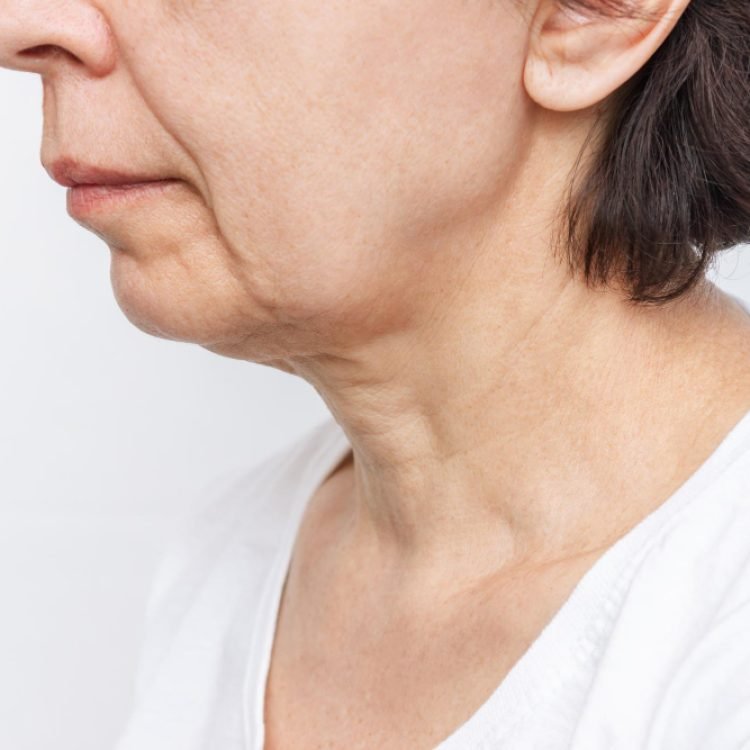
Jowls are soft tissue sitting over the jawline that used to sit above it. That distinction matters, because it separates jowls from a double chin, which is fullness beneath the chin rather than over the jaw.
A cadaver study of the retaining ligaments of the mandible concluded that jowl formation is mainly caused by descent of the cheek fat compartments rather than by loosening of the ligament running along the jaw.
Read that carefully, because it changes the framing. The jowl is not a thing that grows on your jawline. It is cheek tissue that has migrated downward and come to rest there.
That explains why the cheek and the jawline are linked. Anything affecting volume in the mid-face affects what sits along the jaw beneath it, which is covered further in the guide to whether weight loss causes hollow cheeks.
Why losing weight changes what you see along the jaw
Three things happen at once, and they pull in different directions.
Volume leaves the cheek. Less fullness above the jawline means less filling the space, so tissue that had already descended becomes more visible against a flatter background.
Volume leaves the jowl itself. The tissue sitting over the jaw is partly fat, so it also shrinks. In isolation this would improve the appearance.
Skin has to retract. This is the deciding factor. If skin tightens to match the reduced volume, the jaw looks sharper. If it does not, you are left with loose skin over a smaller volume, which reads as jowling.
Which of those dominates depends on age, how quickly the weight came off, and baseline skin quality. Sun protection is the one measure with randomised trial evidence behind it for slowing skin ageing, and NHS advice on sunscreen and sun safety sets out what adequate protection looks like in UK conditions.
A simple check you can do at home
This will not diagnose anything, but it tells you what you are looking at.
Lie flat on your back and look at your jawline in a hand mirror, or tilt your head back and look up. Gravity-dependent descent lifts and largely disappears. Volume and bone do not move.
If the fullness over your jawline vanishes when you lie down, you are looking at descended soft tissue. If it stays put, you are looking at something else, which might be fat beneath the chin, jaw anatomy, or an enlarged chewing muscle at the jaw angle.
The same test tells you whether your jawline changed because of weight loss or because of something else entirely. Descent that is new, one-sided, or firm to the touch is a GP question rather than a mirror question.
What the anatomy does not settle
This is worth stating plainly, because most content on jowls is written with far more confidence than the research supports.
An anatomical review published in Aesthetic Surgery Journal notes that the causes of jowling remain unclear in the literature, that the anatomic basis is multifactorial, and that the changes producing a jowl in any individual case may vary substantially. It also records a live disagreement: some researchers hold that facial retaining ligaments stay taut while unsupported tissue descends around them, while others argue that the ligaments loosen and allow that descent.
So the ingredients are agreed. Soft tissue descends, the cheek deflates, skin loosens, and the muscles pulling the lower face down contract over time. The relative contribution of each is not settled.
What that means for you: be sceptical of anyone offering a confident single explanation for your jawline, and more sceptical still of anyone promising a specific outcome from a single intervention.
Jowls, weight and the UK system
Four points worth knowing.
- Jowling is a normal feature of an ageing face. It is not a condition, nothing in clinical guidance treats it as one, and there is no medical reason to act.
- Nothing here is NHS-funded. Procedures aimed at improving jawline definition for appearance reasons are cosmetic and are not routinely commissioned. Criteria vary between integrated care boards.
- Insurance rarely helps. Most UK private medical insurance policies exclude cosmetic procedures outright.
- Some jawline changes are not about ageing or weight. Swelling that is new, one-sided or firm, or a discrete lump rather than diffuse fullness, is worth a GP appointment. UK guidance treats a persistent unexplained lump in the neck as a reason for prompt assessment.
If you are losing weight under medical supervision and are unhappy with the effect on your face, that is a conversation to have at a review appointment rather than a reason to change anything on your own.
Because anything cosmetic would be self-funded, there is no clinical deadline. The jowls concern page covers the anatomy and causes in more depth, and for detail on self-funded options and what each involves, that sits on Revitalize in Turkey rather than here.
What to ask your doctor
Worth asking a GMC-registered doctor:
- Does this look like descended soft tissue, or is something else going on along my jawline?
- Is anything here new, asymmetric or firm in a way you would want to examine?
- If I am still losing weight, is further change along the jaw likely?
- Given my age, is my skin likely to retract further as my weight stabilises?
- Are there health reasons my current rate of weight loss should stay as it is?
- Is there any medical reason to look into this, or is it entirely cosmetic?
Frequently asked questions
Can losing weight give you jowls?
It can make existing descent more visible rather than creating it. Cheek volume that filled the area above the jawline is reduced, so tissue that had already migrated downward stands out more. In younger people with better skin retraction, the same weight loss often produces a sharper jaw instead.
At what age does weight loss start causing jowls rather than sharper jawlines?
There is no fixed threshold. The change tends to become more likely from around 40 onward, as skin elasticity and collagen decline, but this varies widely between individuals. Genetics, cumulative sun exposure and smoking all affect how well skin retracts, so age alone is a rough guide.
Do jowls from weight loss go away?
Skin can continue retracting for months after weight stabilises, so some improvement is possible, particularly in younger people. Descended fat does not return to its original position on its own. Nobody can predict how much recovery an individual will see, and no reliable timeframe exists.
Are jowls the same as a double chin?
No. Jowls are soft tissue sitting over the jawline that has descended from the cheek. A double chin is fullness beneath the chin, in the submental area. They have different anatomy and different explanations, and someone can have one without the other.
Do facial exercises help jowls after weight loss?
There is no good evidence that they do. Jowls form mainly through descent of cheek fat and loosening of skin rather than loss of muscle tone, so working the muscles does not address the mechanism. No UK clinical guidance recommends facial exercises for jawline definition.
When should jowling be checked by a doctor?
When it is new rather than gradual, affects one side more than the other, feels firm, or presents as a discrete lump rather than soft diffuse fullness. UK guidance treats a persistent unexplained lump in the neck as a reason for prompt assessment. Gradual, symmetrical softening is ordinary ageing.