
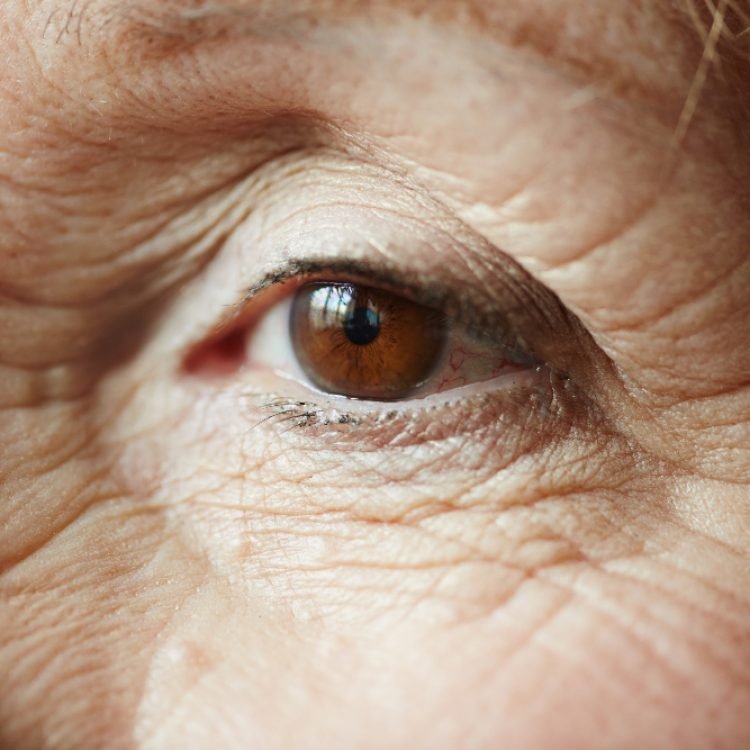
Does Squinting Cause Crow’s Feet?
Does squinting cause crow’s feet? Partly. Squinting creates the fold, but sun damage decides whether that fold becomes permanent. Skin that has kept its elasticity springs back. Skin damaged by years of ultraviolet light does not. Squinting on its own is not enough to produce a lasting line.
That distinction changes what is worth doing about it, and it also raises a more useful question: why are you squinting in the first place?
On this page: The two-part answer · The natural experiment · Dynamic and static lines · Why you might be squinting · A UK wording trap · The UK picture · What to ask · FAQs
Does squinting cause crow’s feet on its own?
No. It takes two things happening together.
Squinting folds the skin at the outer corner of the eye. The orbicularis oculi, the ring of muscle that closes the eye, contracts and the thin skin above it creases. That happens thousands of times a day in everyone who blinks, smiles or steps into bright light.
What determines whether those creases stay is the condition of the skin doing the folding. Collagen and elastin give skin its ability to return to shape. Ultraviolet light degrades both over years, a process called photoageing. Skin with intact elasticity unfolds. Skin without it holds the crease.
So squinting supplies the mechanical force and photoageing supplies the vulnerability. Blaming either alone gets the answer wrong.
The case that shows squinting is not sufficient
There is a striking piece of evidence for this, and almost no article on crow’s feet uses it.
The New England Journal of Medicine published a clinical image of unilateral dermatoheliosis in 2012. A 69-year-old man presented with a 25-year history of gradual thickening and wrinkling of the skin on the left side of his face. He had driven a delivery truck for 28 years. Ultraviolet A rays transmit through window glass, penetrating the epidermis and upper layers of the dermis, and chronic UVA exposure can result in thickening of the skin’s upper layers and destruction of elastic fibres.
Consider what that case controls for. Both sides of the man’s face blinked the same number of times. Both squinted, smiled and frowned identically for 69 years, driven by the same brain and the same muscles. The only variable that differed was ultraviolet exposure through the driver’s window.
One side aged visibly faster. That is about as close to a natural experiment as facial ageing offers, and it points at UV rather than muscle movement as the thing doing the lasting damage.
This does not make squinting irrelevant. It means squinting alone, in skin that has been protected, is not the mechanism people assume it is.
Dynamic lines and static lines are different things
The distinction is worth setting out, because it explains what you are actually looking at.
| Dynamic lines | Static lines | |
|---|---|---|
| When visible | Only while the muscle contracts | Present at rest, without expression |
| What causes them | Muscle movement folding elastic skin | Repeated folding of skin that has lost elasticity |
| Main driver | Facial movement, including squinting | Cumulative photoageing plus age-related skin thinning |
| Do they resolve? | Yes, the moment the face relaxes | No |
| What prevention targets | Reducing how often the fold happens | Reducing UV exposure |
Dynamic lines are not damage. Everyone has them, at every age, and they are the reason a face looks expressive rather than fixed.
The transition from dynamic to static is gradual and nobody can predict when it happens for an individual. Genetics, skin tone, cumulative sun exposure and smoking all feed into it.
Why you might be squinting, and which reasons are fixable
Here is the part that makes this question worth asking. Habitual squinting is usually a response to something, and several of those somethings are worth checking.
Uncorrected vision. Narrowing the eyelids reduces blur from a refractive error, which is why people with uncorrected short-sightedness, long-sightedness or astigmatism squint at distance. It works, briefly, which is exactly why the habit persists rather than prompting a sight test.
Presbyopia. The age-related decline in near focus that typically becomes noticeable from around 40. Squinting at small print is a common early sign.
Glare. Cancer Research UK advises covering up with clothes, a wide-brimmed hat and UV protection sunglasses. Sunglasses reduce the reason to squint and block UV reaching the skin at the same time, which is the only single action addressing both halves of this question.
Dry eye or light sensitivity. Both can produce habitual narrowing of the eyes. Light sensitivity that is new, worsening or affecting one eye more than the other is worth an appointment rather than a pair of sunglasses.
Screens. Poor contrast, glare and long unbroken stretches at a screen produce the same response.
Be straight about the evidence here: no randomised trial has tested whether reducing squinting reduces crow’s feet. The reasoning is anatomically sound and the actions are worth taking for other reasons. That is different from proof.
A wording trap worth knowing in the UK
In British medical usage, “a squint” usually means strabismus, a condition where the eyes point in different directions. That is a distinct thing from screwing up your eyes against glare or blur, which is what this guide is about.
If you search NHS material for “squint” you will mostly find strabismus information, which will not answer this question. If one eye turns inward or outward, or a child’s eyes appear misaligned, that is a genuine eye condition and warrants an appointment rather than a skincare decision.
Squinting, crow’s feet and the UK system
Three practical points.
- Sight tests are free for many people. Free NHS sight tests are available to several groups in England, Wales and Northern Ireland, including people aged 60 and over and children under 16, with wider eligibility on low incomes. In Scotland, NHS eye examinations are available to all residents. If you squint at distance or at small print, an optometrist is the right first stop.
- The UK UV window is longer than people expect. Cancer Research UK states the sun in the UK is often strong enough to cause damage between mid-March and mid-October, even when cold or cloudy, and advises acting when the UV index reaches 3 or above. NHS advice on sunscreen and sun safety recommends shade between 11am and 3pm from March to October and notes most people apply too little sunscreen.
- Nothing cosmetic here is NHS-funded. Procedures aimed at softening lines around the eyes are cosmetic and are not routinely commissioned. Private medical insurance almost always excludes them.
Because any procedure would be self-funded, there is no clinical clock running. The crow’s feet concern page covers what causes them in more depth, and the guide to whether crow’s feet can be prevented ranks the preventive options against each other. For detail on self-funded options and what each involves, that sits on Revitalize in Turkey rather than here.
What to ask your doctor or optometrist
Worth asking a GMC-registered doctor or a registered optometrist:
- Do I have an uncorrected refractive error that would explain habitual squinting?
- Is my near vision changing in a way that makes me narrow my eyes to read?
- Could dry eye or light sensitivity be contributing, and is either worth treating?
- Are my sunglasses actually providing UV protection, or only tint?
- Is my sun protection routine adequate for UK conditions?
- Is there anything about the skin around my eyes worth looking at medically rather than cosmetically?
Frequently asked questions
Does squinting cause permanent wrinkles?
Not by itself. Squinting folds the skin, but whether folds become permanent depends on how much elasticity the skin has lost, which is driven largely by cumulative ultraviolet exposure and age. Repeated squinting in well-protected skin produces dynamic lines that resolve when the face relaxes rather than lasting creases.
Will wearing sunglasses stop crow’s feet?
Not stop, but plausibly slow. Sunglasses block ultraviolet light reaching the skin around the eye and remove one common reason to squint, addressing both parts of the mechanism. Cancer Research UK recommends UV protection sunglasses as part of sun safety. No trial has tested sunglasses specifically for preventing crow’s feet.
Can getting glasses reduce crow’s feet?
It can reduce habitual squinting if uncorrected vision is why you squint, which is worth doing regardless. Whether that translates into fewer lines has not been tested in any trial. Treat improved vision as the reason to book a sight test and any skin benefit as an unproven possibility.
Do people who squint more get crow’s feet earlier?
The evidence does not answer this cleanly. Facial expressiveness plausibly contributes, but cumulative sun exposure, genetics, skin tone and smoking all influence when lines become permanent. No study isolates squinting frequency as a variable, so anyone claiming a firm answer is going beyond what has been measured.
Is squinting bad for your eyes?
Squinting itself is not thought to damage the eye. It is more useful as a signal, because habitual squinting often indicates uncorrected vision, presbyopia, dry eye or light sensitivity. If you squint regularly, an optometrist can identify why. New or one-sided light sensitivity warrants an appointment sooner.
Are crow’s feet caused by smiling too?
Smiling contracts the same muscle around the eye and folds the same skin, so it contributes to dynamic lines in the same way squinting does. Unlike squinting, smiling is not a symptom of anything correctable. Sun protection remains the lever with evidence behind it rather than reducing facial expression.