Do Repeated Expressions Cause Frown Lines?
Do repeated expressions cause frown lines? They create the fold, but skin quality decides whether it stays. Frowning contracts the muscles between your brows and creases the skin. Whether that crease springs back depends on collagen and elastin, which decline with age and sun exposure.
That makes frown lines unusual among facial lines, because the expression causing them is one you might genuinely want to reduce.
On this page: The two-part answer · Why frown lines are different · Why you frown · Does frowning affect mood? · The resting frown problem · The UK picture · What to ask · FAQs
Do repeated expressions cause frown lines on their own?
No. Two things have to happen together.
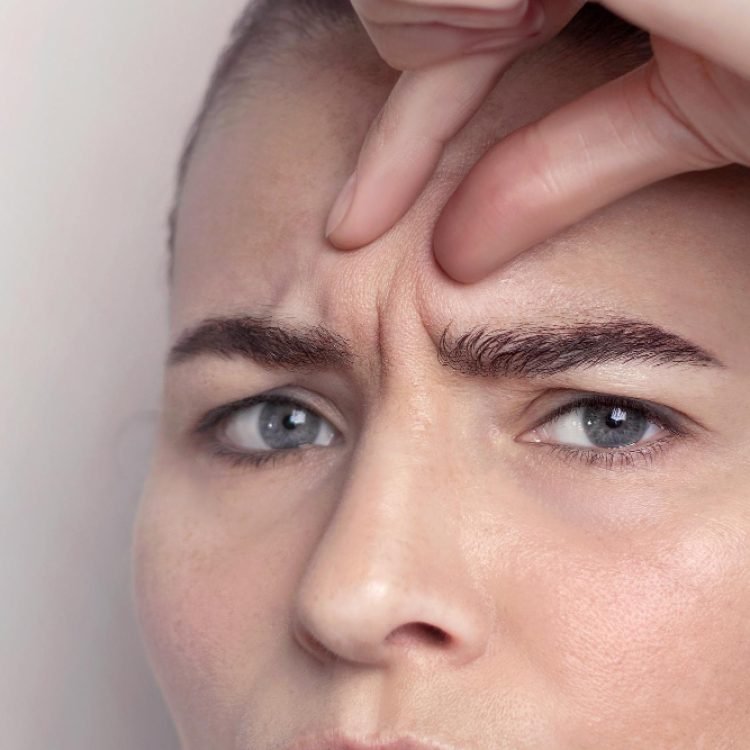
Frowning contracts the corrugator and procerus muscles, which sit between and just above the eyebrows. They pull the brows inward and down, folding the skin vertically. Those vertical creases are why frown lines are sometimes called elevens.
Whether the fold becomes permanent depends on the skin doing the folding. Collagen and elastin let skin return to shape. Both decline with age and with cumulative ultraviolet exposure, a process called photoageing. Elastic skin unfolds. Skin that has lost elasticity holds the crease.
So expression supplies the movement and photoageing supplies the vulnerability. Someone who frowns constantly but has protected their skin will hold dynamic lines for far longer than someone who frowns rarely but has decades of unprotected sun exposure.
The frown lines concern page covers the anatomy and causes in more detail.
Why frown lines are different from other expression lines
This is where the answer stops being generic, and it is the reason this question is worth asking at all.
Most expression lines come from movements you would not want to give up. Crow’s feet come largely from smiling. Nobody sensibly recommends smiling less, and the guide to whether squinting causes crow’s feet covers that trade-off.
Frowning is different. A large share of habitual frowning is not emotional at all. It happens while concentrating, reading small print, staring at a screen, or squinting into bright light. Those contractions serve no purpose and carry no upside.
That makes frown lines the one facial line where noticing a habit is genuinely worth doing. Not because the evidence proves it works, but because unlike smiling, there is nothing to lose by frowning less at your monitor.
Be straight about the evidence: no randomised trial has tested whether reducing habitual frowning reduces frown lines. The anatomy is sound and the reasoning is reasonable. That is not the same as proof.
Why you frown, and which reasons are fixable
Habitual frowning is usually a response to something. Several of those things are checkable.
| Trigger | What it looks like | Fixable? |
|---|---|---|
| Uncorrected vision | Frowning at distance, small print or road signs | Yes. A sight test answers it |
| Presbyopia | Age-related decline in near focus, common from around 40 | Yes, with correction |
| Screen glare and poor contrast | Worse late in the working day | Often, through display and lighting changes |
| Bright light | Frowning outdoors, especially driving into low sun | Yes, with UV-protection sunglasses |
| Pain and headache | Frowning alongside head, neck or jaw discomfort | Depends on the cause. Worth a GP appointment |
| Concentration and stress | Frowning while thinking, unaware of doing it | Partly, through noticing rather than effort |
Presbyopia is the age-related loss of near focus that makes small print harder to read.
Cancer Research UK advises covering up with clothes, a wide-brimmed hat and UV protection sunglasses. Sunglasses do double duty here: they reduce the glare that makes you frown, and they block ultraviolet light reaching the skin.
If you frown at distance or at small print, an optometrist is a more useful first appointment than a skincare aisle.
Does frowning affect how you feel, or only how you look?
This is a fair question and the honest answer is that it is contested.
The idea that facial expression influences emotion is called the facial feedback hypothesis. It came from a well-known 1988 study, and it did not survive testing well. The Association for Psychological Science reported that a 17-laboratory replication effort found no evidence that surreptitiously inducing people to smile or frown affected their emotional state.
Later work has been more nuanced rather than dismissive. A subsequent meta-analysis pooling a large number of studies found a statistically significant effect, but a small and highly variable one that depends heavily on context and method.
Where that leaves you: the effect, if it exists, is modest and inconsistent. Anyone telling you that frowning less will reliably improve your mood is overstating what the research supports. Anyone telling you the idea has been debunked outright is also overstating it.
The resting frown problem nobody writes about
There is a social dimension to this that cosmetic content rarely acknowledges.
Once vertical lines become visible at rest, some people find they are consistently read as angry, tired or unapproachable when they feel none of those things. Colleagues ask if something is wrong. Photographs look severe.
That mismatch between how a face reads and how a person feels is a legitimate reason to be bothered, and it is different from wanting to look younger. It is worth naming, because it often goes unspoken and can make the concern feel harder to justify than it should.
Frown lines are a normal feature of a face that has moved and aged. Nothing in medicine treats them as a problem needing correction. Whether they bother you is a separate question, and a valid one.
Frown lines and the UK system
Four practical points.
- Sight tests are free for many people. Free NHS sight tests cover several groups in England, Wales and Northern Ireland, including people aged 60 and over and children under 16, with wider eligibility on low incomes. In Scotland, NHS eye examinations are available to all residents.
- Sun protection has the strongest evidence for the skin side. NHS advice on sunscreen and sun safety recommends shade between 11am and 3pm from March to October, and notes most people apply too little.
- Cosmetic treatment is not NHS-funded. Procedures aimed at softening lines between the brows are cosmetic and are not routinely commissioned. Private medical insurance almost always excludes them.
- Some brow changes are not cosmetic. Sudden asymmetry, a brow or eyelid that has dropped, or an inability to raise one eyebrow needs prompt medical assessment rather than a cosmetic consultation. If one side of your face has dropped suddenly, call 999.
Because anything cosmetic would be self-funded, there is no clinical deadline and no reason to hurry a decision. For detail on self-funded options and what each involves, that sits on Revitalize in Turkey rather than here.
What to ask your doctor or optometrist
Worth asking a GMC-registered doctor or a registered optometrist:
- Do I have an uncorrected refractive error that would explain frowning at distance or near?
- Is my near vision changing in a way that makes me screw up my face to read?
- Could headaches, jaw tension or eye strain be driving this?
- Are my sunglasses providing genuine UV protection or only tint?
- Is my sun protection adequate for UK conditions?
- Is there anything about my brows or forehead that looks medical rather than cosmetic?
Frequently asked questions
Do frown lines mean you frown a lot?
Not necessarily. Frown lines reflect both how often the muscles between the brows contract and how much elasticity the skin has lost, which is driven largely by age and cumulative sun exposure. Someone with heavy sun exposure can develop visible lines without frowning unusually often, and the reverse is also true.
At what age do frown lines appear?
There is no set age. Lines visible only during expression can show in the twenties or earlier. Lines present at rest generally appear later, though timing varies widely with genetics, skin tone and sun exposure. Comparison with people your own age tells you very little about your own trajectory.
Can you prevent frown lines by frowning less?
Plausibly, but it has not been tested. No randomised trial has examined whether reducing habitual frowning reduces line formation. The anatomy supports the idea, and unlike smiling there is no downside to frowning less at a screen. Treat it as reasonable rather than proven.
Will glasses stop me getting frown lines?
Correcting vision can reduce habitual frowning if uncorrected sight is why you frown, which is worth doing regardless. Whether that translates into fewer lines has not been studied. Book a sight test for the vision benefit and treat any effect on your forehead as an unproven possibility.
Does frowning make you feel worse?
The evidence is contested. A 17-laboratory replication effort found no evidence that inducing people to frown or smile changed their emotional state, though a later meta-analysis found a small, highly variable effect. The honest position is that any influence of expression on mood is modest and inconsistent.
When are frown lines a medical concern?
Frown lines themselves are not. Sudden changes are different: asymmetry between the brows, a brow or eyelid that has dropped, or being unable to raise one eyebrow all need prompt assessment. Sudden drooping on one side of the face is a medical emergency and warrants calling 999 immediately.