Do Hormones Cause Acne? What UK Doctors Actually Look For
Do hormones cause acne? Yes, in large part. Androgens rise during puberty and make the skin’s oil glands bigger and more active, which is how acne begins. But most people with hormonal acne have hormone levels in the normal range, so UK guidance does not recommend hormone testing for everyone with acne.
That last point changes what you do next. This guide covers when hormone testing is worth asking about, and what a UK doctor does with the answer.
On this page: How hormones drive acne · Why normal hormones still cause acne · When testing is indicated · Hormonal triggers beyond puberty · The UK pathway · What to ask your doctor · FAQs
Do hormones cause acne directly, or just make it more likely?
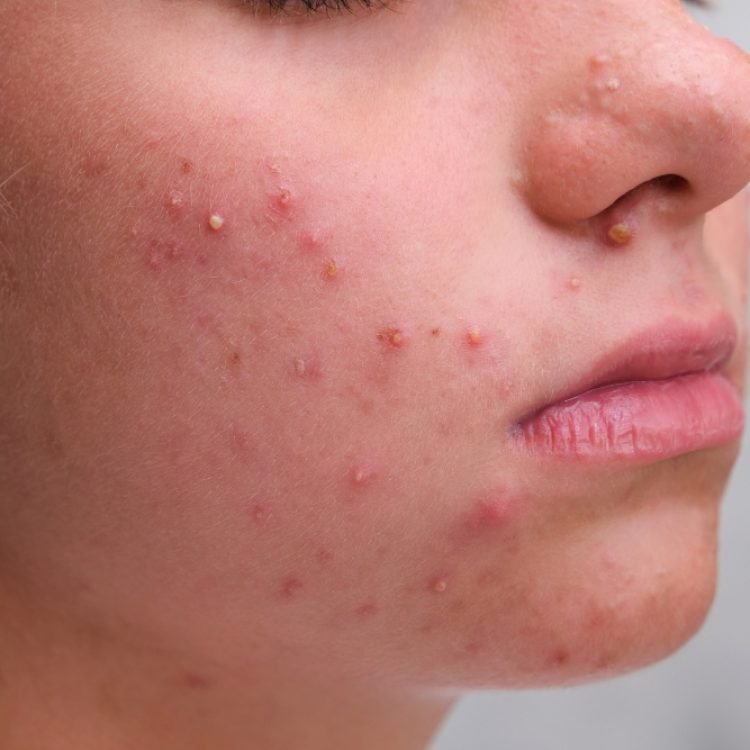
Androgens are a group of hormones present in everyone, testosterone being the best known. During puberty, androgen levels rise and enlarge the sebaceous glands, the oil glands attached to hair follicles. Those glands then produce more sebum, the oil that lubricates skin and hair. Sebum mixing with dead skin cells can plug a follicle, and a spot forms.
The NHS links acne to hormonal changes during puberty, and notes that acne runs in families, which is why two people with similar hormone levels can have very different skin. The acne concern page sets out the full mechanism.
So hormones are necessary for acne but not sufficient alone. Genetics, skin barrier function and inflammation all shape whether that hormonal signal produces spots.
Why “hormonal acne” usually does not mean abnormal hormones
Do hormones cause acne by being abnormal? Usually not, and that is the part missing from most articles on this subject.
Studies measuring blood androgen levels in women with acne have often found them sitting within the normal range. A cross-sectional study of 70 Nigerian women with acne and 70 without found no statistically significant difference in serum testosterone between the two groups, and no relationship between androgen levels and acne severity. The authors still recommended checking androgen levels in severe or treatment-resistant cases, which is a narrower recommendation than testing everyone.
The working explanation among dermatologists is that acne reflects how sensitive the sebaceous glands are to ordinary androgen levels, rather than how high those levels are. That is a hypothesis with reasonable support rather than settled fact.
The practical consequence is straightforward. A normal hormone blood test does not mean your acne is not hormonal. It usually means your hormones are behaving normally and your skin is responding strongly, which is the common picture.
When hormone testing is actually indicated
UK clinical guidance treats endocrine investigation as the exception rather than the rule. Most people with acne need no blood tests at all.
Writing in the Royal Pharmaceutical Society’s Pharmaceutical Journal, UK authors note that acne is usually diagnosed from skin examination alone and rarely requires additional investigation, but that an endocrine disorder such as hyperandrogenism should be investigated where suspected. Hyperandrogenism means higher-than-usual levels of male-type hormones.
The signs that shift the balance towards testing are specific.
| Sign | Why it matters | What it may point to |
|---|---|---|
| Irregular, infrequent or absent periods | Menstrual disruption alongside acne suggests a hormonal driver rather than skin sensitivity alone | Polycystic ovary syndrome (PCOS) or another endocrine condition |
| Excess hair growth in a male pattern (hirsutism) | One of the recognised outward signs of higher androgen levels | Hyperandrogenism |
| Hair thinning at the scalp in a male pattern | Another recognised androgen-related sign | Hyperandrogenism |
| Acne starting for the first time after 25 | Late-onset acne is less common and prompts a closer look at causes | Underlying endocrine cause worth excluding |
| Sudden severe acne, or acne that resists treatment | Named in UK guidance as a trigger for investigating endocrine causes | Hyperandrogenism or a drug cause |
| Taking anabolic steroids or testosterone | NICE NG198 specifically names self-administered anabolic steroids as a possible contributor | A drug cause rather than a disorder |
If none of those apply, a UK GP is unlikely to order hormone tests, and that is consistent with guidance rather than a brush-off.
Hormonal triggers beyond puberty
Several hormonal situations affect acne in adults, and they are worth naming separately.
The menstrual cycle. Premenstrual acne flares are commonly reported. One Pharmaceutical Journal review puts the figure at around 60% of women with acne, though flare reporting relies on self-observation, so treat that as an approximation rather than a precise rate.
Contraception. NICE guideline NG198 advises that if someone receiving acne treatment wants hormonal contraception, the combined oral contraceptive pill should be considered in preference to the progestogen-only pill. Progestogen-only contraception is recognised as a possible acne trigger for some people.
PCOS. NICE sets out specific management for people with acne and polycystic ovary syndrome, and advises considering referral to an appropriate specialist, such as a reproductive endocrinologist, for those with additional features of hyperandrogenism.
Medication and hormone therapy. NICE advises considering condition-specific management or specialist referral if a medical disorder or medication is likely to be contributing. Acne is a recognised effect of testosterone used in gender-affirming hormone therapy, and of corticosteroids given by any route.
Pregnancy and perimenopause. Both involve substantial hormonal shifts, and acne can improve or worsen in either. The evidence is largely observational, and there is no reliable way to predict which direction an individual will go.
Hormonal acne and the UK system
Three things shape how this plays out with a UK GP.
- You are unlikely to be tested without a specific sign. UK guidance frames endocrine investigation as appropriate when hyperandrogenism is suspected, not as routine. If you have a relevant sign, say it explicitly at the appointment rather than assuming it will be asked about.
- A suspected endocrine cause goes to endocrinology, not dermatology. NHS formulary guidance based on NICE NG198 and NICE Clinical Knowledge Summaries states that patients presenting with acne with a suspected endocrinological cause should be referred to an endocrinologist rather than a dermatologist. Knowing which door you are aiming for saves time.
- Then there is the wait. The NHS standard is a maximum 18-week wait from referral to the start of consultant-led treatment. Waits vary widely by trust and specialty, and the standard is not currently met nationally.
A word on private hormone panels. Direct-to-consumer testing kits marketed for hormonal acne typically measure a broad panel of hormones. Because most people with acne have normal levels, a normal result is the likely outcome and tells you little you did not already know. An abnormal result still needs a doctor to interpret it in context. If you want testing, asking a GMC-registered GP whether it is clinically indicated is a more useful starting point than buying a panel and working backwards.
Acne timing is also informative here, since first-time acne after 25 is one of the signs that prompts a closer look. That pattern is covered in the guide to what age acne usually starts.
If you want detail on self-funded treatment options and what each involves, that sits on Revitalize in Turkey rather than on this site.
What to ask your doctor
Worth asking a GMC-registered doctor:
- Based on my history, is there anything that makes you suspect a hormonal cause beyond ordinary puberty or cycle effects?
- Are my periods, hair growth or hair thinning patterns relevant here, and have you factored them in?
- If you are not testing my hormones, what would change your mind?
- Could my current contraception be contributing, and is switching worth considering?
- If a hormonal cause is suspected, would you refer me to endocrinology or dermatology, and why?
- What would a normal hormone result actually rule out in my case?
Frequently asked questions
Do hormones cause acne in adults as well as teenagers?
Yes. Androgens continue to influence sebum production throughout adult life, and hormonal shifts around the menstrual cycle, pregnancy, contraception changes and perimenopause can all affect acne. Adult acne is usually acne that continued from adolescence rather than a new hormonal problem, though acne starting after 25 is worth raising with a GP.
Can you have hormonal acne with normal blood test results?
Yes, and it is the usual situation. Research measuring androgen levels in women with acne has often found no significant difference from women without acne. A normal result generally means your hormones are behaving normally while your oil glands respond strongly, which does not make the acne any less real or less treatable.
Should I ask my GP for a hormone test for my acne?
Only if you have a specific sign. UK guidance treats endocrine investigation as appropriate where hyperandrogenism is suspected, for example alongside irregular periods, excess hair growth, scalp hair thinning, or sudden severe or treatment-resistant acne. Without those, a GP is unlikely to test, and that follows guidance rather than dismissing you.
Does the contraceptive pill affect acne?
It can, in either direction. NICE guideline NG198 advises considering the combined oral contraceptive pill in preference to the progestogen-only pill for people receiving acne treatment who want hormonal contraception. Progestogen-only methods are recognised as a possible acne trigger for some people. Discuss options with a GMC-registered doctor.
Is hormonal acne different from ordinary acne?
Not as a separate diagnosis. UK clinical guidance grades acne by lesion count and type rather than by presumed hormonal cause. “Hormonal acne” is a descriptive term people use for acne that flares with the cycle or sits along the jaw and chin, not a distinct condition with its own treatment pathway.
Does stress cause hormonal acne?
The link is plausible but not well established. Stress raises cortisol, which can influence sebum production, and some studies report worse acne during stressful periods. The research is mostly observational and cannot separate stress from sleep, diet and skin-picking behaviour, so the evidence does not support treating stress as a proven acne cause.