
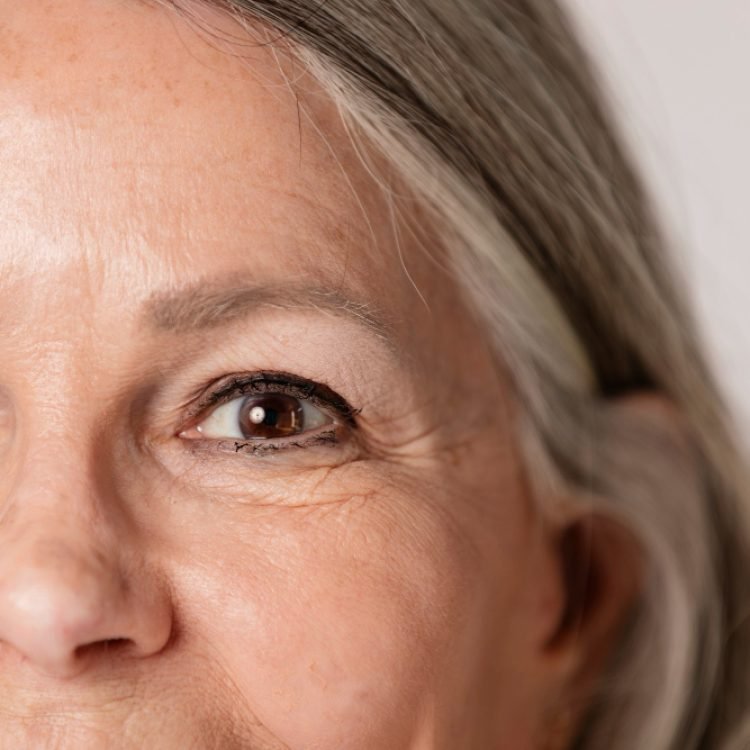
Can Crow’s Feet Be Prevented?
Can crow’s feet be prevented? Delayed, partly. Not prevented outright. Crow’s feet come from two separate processes, and only one of them has decent evidence behind prevention. Sun protection has a randomised trial supporting it. Reducing repeated squinting is mechanistically sensible but barely studied.
Knowing which mechanism a piece of advice addresses is the difference between doing something useful and buying something hopeful.
On this page: The two mechanisms · What the trial evidence shows · The squinting side · The levers ranked · What does not work · The UK picture · What to ask your doctor · FAQs
Can crow’s feet be prevented, or only delayed?
Only delayed, and only partly. The lines at the outer corner of the eye form through two processes running at once.
Photoageing. Ultraviolet light degrades collagen and elastin in the skin over years. This is cumulative, it happens in ordinary daylight rather than only on holiday, and it is the process sun protection acts on.
Repeated muscle contraction. The orbicularis oculi is the ring of muscle around the eye that closes it. Every squint, smile and blink folds the thin skin above it. Over decades, folds that once sprang back start to stay.
Skin also thins and loses elasticity with age regardless of either. That third process is not preventable at all, which is why “prevented” is the wrong word and “delayed” is the honest one.
Worth saying at the outset: crow’s feet are a normal feature of a face that has moved and aged. Nothing in medicine treats them as a problem needing correction.
What the trial evidence actually shows
This is where most articles overstate their case, so the detail matters.
A randomised controlled trial published in Annals of Internal Medicine followed 903 adults under 55 in Nambour, Australia, for four and a half years. Participants were assigned to daily broad-spectrum sunscreen use or discretionary use, with or without beta-carotene supplements. The daily sunscreen group showed significantly less skin ageing than the discretionary group. Beta-carotene showed no effect on skin ageing.
That is genuinely strong evidence, and it is the best available. Three caveats belong with it.
The trial ran at latitude 26 degrees south, in subtropical Queensland, where UV exposure is far higher than anywhere in the UK. The effect size in British conditions is an extrapolation, not a finding. It measured overall photoageing rather than crow’s feet specifically. And it compared daily use against discretionary use, not against nothing, so the comparison is more demanding than it first appears.
None of that undermines the conclusion. It does mean anyone telling you sunscreen has been proven to prevent crow’s feet in the UK is going beyond what was tested.
The squinting side has almost no evidence behind it
Crow’s feet are partly dynamic lines, meaning they deepen when the muscle contracts. It follows that contracting the muscle less often would slow their formation. That reasoning is sound, and it has barely been tested.
There is no randomised trial showing that reducing squinting prevents crow’s feet. What exists is anatomy and plausibility. Treat advice in this area as reasonable rather than proven, and be sceptical of anyone claiming otherwise.
Three things drive habitual squinting, and two of them are fixable.
Glare. Cancer Research UK advises covering up with clothes, a wide-brimmed hat and UV protection sunglasses. Sunglasses are the one action that addresses both mechanisms at once: they block UV reaching the skin around the eye and remove the reason to squint.
Uncorrected vision. If you narrow your eyes to read signs or screens, that is a sight test question rather than a skincare one.
Screens and lighting. Poor contrast and glare on screens produce the same squinting response over long working days.
The levers, ranked by what they address and how well
Sorted honestly rather than presented as an equal checklist.
| Lever | Which mechanism | Evidence | Worth prioritising? |
|---|---|---|---|
| Daily broad-spectrum sunscreen | Photoageing | Randomised trial evidence for skin ageing generally, in a high-UV setting | Highest. Also reduces skin cancer risk, which matters more |
| UV-protection sunglasses | Both | Sun protection is well supported; the squinting benefit is plausible, not tested | High, and the only lever hitting both mechanisms |
| Correcting your vision | Squinting | Untested for wrinkles. Worth doing on its own merits | Moderate, and free for many people in the UK |
| Not smoking | Skin ageing generally | Widely reported association with premature skin ageing | Moderate for skin, considerable for everything else |
| Shade and hats during UK UV months | Photoageing | Follows the same logic as sunscreen | Moderate. Works alongside sunscreen rather than instead |
Broad-spectrum means a sunscreen that protects against both UVA and UVB. Photoageing means skin ageing caused by ultraviolet exposure rather than by time alone.
So can crow’s feet be prevented by effort alone? No. But the ranking has a useful implication: the best-evidenced action is also the one dermatologists recommend for reasons unrelated to wrinkles.
What does not prevent crow’s feet
On the evidence, none of the following does anything useful.
Facial exercises. The logic runs backwards. Crow’s feet form partly through repeated muscle contraction, so contracting the muscle more deliberately is not an obvious preventive strategy. Evidence for facial exercise is thin either way.
Expensive creams as a substitute for sun protection. The trial evidence sits with daily sunscreen use, not with any moisturiser. Products may improve how skin looks and feels. That is not the same as preventing lines from forming.
Beta-carotene supplements. The same Annals of Internal Medicine trial tested these directly and found no effect on skin ageing. That is an unusually clean negative result for a supplement.
Avoiding smiling. Sometimes suggested, occasionally seriously. The trade is obviously bad, and no evidence supports it.
Preventing crow’s feet in the UK
British conditions change the advice in ways global content usually misses.
- The UV window is longer than people assume. Cancer Research UK states that in the UK the sun is often strong enough to cause damage between mid-March and mid-October, even when it is cold or cloudy, and advises checking the UV index and acting when it is 3 or above.
- The NHS gives specific application guidance. NHS advice on sunscreen and sun safety recommends spending time in the shade between 11am and 3pm from March to October, notes most people apply too little, and advises reapplying after swimming, sweating or towel drying.
- Sight tests are free for many people. Free NHS sight tests are available to several groups in England, Wales and Northern Ireland including people aged 60 and over and children under 16, with wider eligibility on low incomes. In Scotland, NHS eye examinations are available to all residents. If squinting at distance is habitual for you, that is worth checking.
- Nothing here is NHS-funded as a cosmetic matter. Procedures aimed at softening crow’s feet are cosmetic and are not routinely commissioned. Private medical insurance almost always excludes them too.
Because any procedure would be self-funded, there is no clinical clock running and no reason to hurry a decision. The crow’s feet concern page covers what causes them in more depth, and for detail on self-funded options and what each involves, that sits on Revitalize in Turkey rather than here.
What to ask your doctor
Worth asking a GMC-registered doctor, pharmacist or optometrist:
- Is my sun protection routine adequate for UK conditions, or am I underusing it?
- Do I squint at distance without noticing, and would a sight test be worthwhile?
- Are any medicines I take likely to increase my skin’s sun sensitivity?
- Is there anything about the skin around my eyes that is worth looking at medically rather than cosmetically?
- Given my skin tone and history, how much difference is sun protection realistically likely to make?
- Is any product I am already using doing anything the evidence supports?
Frequently asked questions
At what age do crow’s feet start?
There is no set age, and it varies widely. Lines that appear only when you smile can show in the twenties or earlier, particularly with high sun exposure. Lines visible at rest generally appear later. Genetics, cumulative UV exposure, skin tone and how expressive your face is all contribute, so comparison with peers tells you little.
Does sunscreen really prevent crow’s feet?
It slows photoageing, which is one of two mechanisms behind crow’s feet. A randomised trial in Australia found daily sunscreen use produced significantly less skin ageing than discretionary use over four and a half years. That trial measured overall photoageing, not crow’s feet specifically, and ran in far higher UV conditions than the UK.
Do sunglasses help prevent crow’s feet?
Plausibly, on two fronts. Sunglasses block UV reaching the delicate skin around the eye, and they remove one common reason to squint. Cancer Research UK recommends UV protection sunglasses as part of sun safety. The squinting benefit is mechanistically sensible rather than proven by trial evidence.
Can facial exercises prevent crow’s feet?
The logic works against itself. Crow’s feet form partly through repeated contraction of the muscle around the eye, so deliberately contracting it more is a questionable prevention strategy. Evidence for facial exercises is limited in either direction. No UK clinical guidance recommends them for preventing lines around the eyes.
Is it too late to prevent crow’s feet if I already have some?
Prevention still applies to future change. Sun protection slows ongoing photoageing whatever has already formed, and cumulative UV exposure continues to accumulate. Existing lines will not reverse through sun protection alone. The reasonable framing is slowing what comes next rather than undoing what is there.
Are crow’s feet a medical problem?
No. Crow’s feet are a normal consequence of facial movement and ageing skin, and no clinical guidance treats them as a condition. Whether you want to change how they look is a personal decision rather than a health one. Sun protection is worth doing for skin cancer risk regardless of how you feel about lines.