
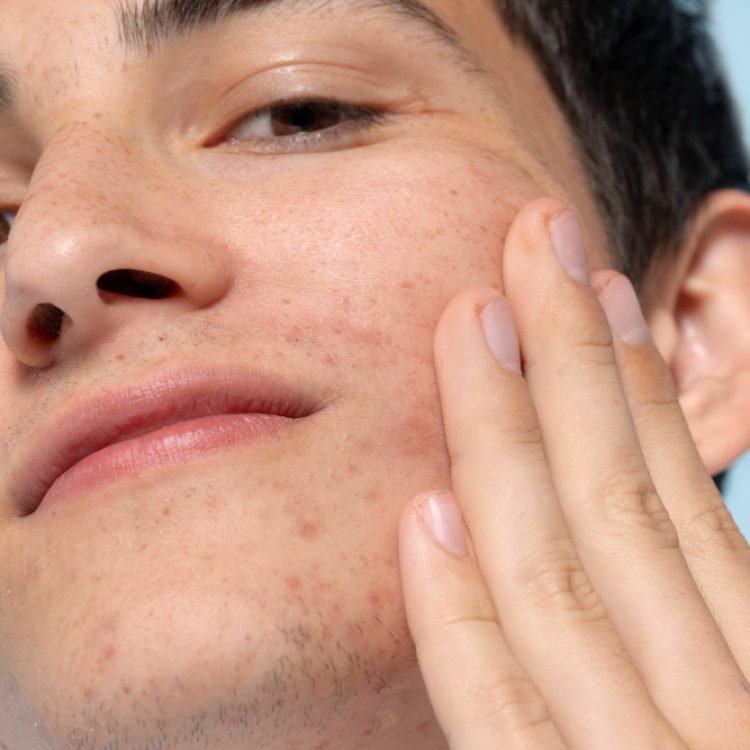
At What Age Does Acne Scarring Usually Start?
At what age does acne scars usually start? Scars can begin as soon as inflamed acne does, most often in the mid-teens, with the highest-risk window falling between 14 and 19. Age itself is not the driver. Acne severity, how long it stays inflamed and genetics matter far more.
That is why the question resists a single number. Acne scars has no onset age of its own. It borrows one from the acne underneath it.
On this page: Why scarring has no age of its own · The highest-risk window · Marks that fade vs scars that stay · What raises the risk · Spotting it early · The UK picture · What to ask your doctor · FAQs
Why acne scarring has no starting age of its own
Scarring is a consequence, not a stage. It happens when inflammation damages the skin below the surface and the repair leaves tissue permanently altered. That can occur at 12 or at 35. What it requires is inflamed acne, not a particular birthday.
A review of acne scar pathogenesis states that inflammatory acne lesions can result in permanent scars, and that their severity may depend on delays in treating the acne. The same review notes the pathogenesis of acne scars is still not fully understood, which is worth stating plainly.
So the useful question is not “how old will I be when scars start” but “do I have the kind of acne that scars”. Comedones, meaning blackheads and whiteheads, rarely scar. Inflamed papules, pustules and nodules can.
At what age does acne scarring usually start in practice?
Scarring clusters where inflamed acne clusters, and that means adolescence.
A review in Clinical, Cosmetic and Investigational Dermatology states that acne scarring develops during the peak onset of active acne, generally between 14 and 19. That aligns with NHS information, which identifies acne as most common in girls aged 14 to 17 and boys aged 16 to 19.
Scarring is already established by the end of that window in a substantial minority. A population study of 2,201 eighteen-year-old males in southern Brazil, examined by dermatologists, found acne scarring in 22%. The cheek area was affected in 80% of those with scars, the forehead in 31.5%, the back in 17%, the chest in 8.2% and the chin in 6.4%. The study found a correlation between acne severity and the presence of scars.
Two caveats. That study covers 18-year-old males in one Brazilian city, so it does not transfer directly to UK women or other age groups. Prevalence figures for acne scarring also vary widely by population and grading method. Treat 22% as one measurement rather than the number.
Marks that fade and scars that stay are not the same thing
Most people who think scars have started are looking at something that will fade. Getting this right changes what you do next.
| Post-inflammatory marks | True acne scars | |
|---|---|---|
| What you see | Flat brown, purple or red patches | A dent, pit or raised lump. The surface is not level |
| What has happened | Pigment or blood vessel change in intact skin | The skin’s structure is permanently altered |
| Timeline | Usually fade over months, though slowly | Permanent without intervention |
| When it appears | As the spot heals | As the spot heals, or later once swelling settles |
| Clinical term | Post-inflammatory hyperpigmentation or erythema | Atrophic scars (indented) or hypertrophic scars (raised) |
Post-inflammatory hyperpigmentation is darkening of the skin after inflammation. Post-inflammatory erythema is the red or purple version, more common in lighter skin tones. Neither involves lost or excess tissue, which is why both can fade.
A rough test is light. Flat marks stay flat under angled light. True scars cast a shadow or catch the light differently, because the surface is no longer even.
What actually raises the risk, if not age
Four factors show up consistently in the research, and none of them is age on its own.
Acne severity. NICE guideline NG198 states that scarring risk increases with the severity and duration of acne.
How long acne stays untreated. NICE’s own evidence review on scarring risk factors found that acne severity and delaying treatment may be risk factors, but described substantial uncertainty because the studies did not control for other influencing factors. The committee judged that delayed treatment may not necessarily lead to scars in mild to moderate acne, while being more of a risk when severe acne is not treated quickly enough.
Picking and squeezing. NICE states that persistent picking or scratching of acne lesions can increase scarring risk. This is the one factor entirely within your control.
Earlier onset of acne. A cross-sectional study of 269 patients at a Turkish dermatology clinic found acne scars in 71.3%, and reported that younger age, earlier onset and adolescent-onset acne were significantly associated with greater severity and scarring, with male sex and severe acne further increasing risk. Early onset probably matters because it means a longer run of inflamed acne, not because young skin scars more readily.
Put together: someone with inflamed acne from 12 to 16 untreated carries more scarring risk than someone who develops mild acne at 16 and treats it. Duration and severity are doing the work, not age.
Spotting acne scarring early
Early scarring is easy to miss because active acne obscures it. Three things are worth watching.
A dent that stays after the spot has gone. If redness has resolved but the surface is still uneven after several months, that is structural rather than pigmentary.
Repeated spots in the same place. Recurrent inflammation at one site raises local risk.
Deep, painful lumps. Nodules sit deeper than papules or pustules and carry the highest scarring risk of any acne lesion.
There is no reliable way to predict who will scar. That uncertainty is genuine, and it is why UK guidance focuses on treating inflamed acne promptly rather than identifying future scarrers.
Acne scarring and the UK system
Two features of the UK pathway matter specifically for scarring.
- Scarring is a referral criterion in its own right. NICE advises considering referral to a consultant dermatologist-led team if acne is leading to scarring, or if there are persistent pigmentary changes. You do not have to complete the usual two 12-week treatment courses before raising it.
- Waits still apply. The NHS standard is a maximum 18-week wait from referral to the start of consultant-led treatment, though dermatology waits vary widely by trust and the standard is not currently met.
One practical point deserves directness. NHS treatment for established scarring is generally limited, because most procedures for it are classed as cosmetic and are not routinely commissioned. Criteria vary between integrated care boards, so availability depends on where you live. Ask your GP what your local policy says.
Private cover rarely helps either. Many UK policies exclude both cosmetic procedures and chronic or pre-existing conditions, and acne scarring often falls under one or both. For detail on self-funded options and what each involves, that sits on Revitalize in Turkey rather than here.
Because prevention outperforms correction, the timing question for active acne matters more than it looks. The guide to when to do something about acne sets out the trigger points, and the acne scars concern page covers scar types and causes.
What to ask your doctor
Worth asking a GMC-registered doctor:
- Looking at my skin now, are these marks pigmentary or structural, and how can you tell?
- Given my acne severity, would you class me as at raised risk of scarring?
- Is there early scarring here that I should know about before I decide on treatment?
- Does the presence of scarring change whether you would refer me, and how soon?
- What does my local integrated care board fund for acne scarring, if anything?
- If I have marks that may fade on their own, roughly how long would you give them before reassessing?
Frequently asked questions
Can acne scarring start in your early teens?
Yes. Scarring follows inflamed acne rather than a set age, so it can begin whenever inflammatory spots do, including at 12 or 13. Blackheads and whiteheads rarely scar. Papules, pustules and nodules can. Research links earlier acne onset to greater scarring, most likely because it means a longer overall run of inflammation.
How long after a spot does a scar appear?
There is no fixed interval, and the evidence does not support one. Some scarring is visible as the spot heals; other scars become obvious only once swelling and redness settle over following weeks. Flat marks that persist beyond a few months without the surface becoming uneven are usually pigmentary rather than true scars.
Do acne scars get worse with age?
Established scars do not deepen on their own, but they can become more noticeable over time. Skin loses collagen and elasticity with age, which can make indented scars appear more pronounced in later decades. That is a change in visibility rather than new scarring. New scars require new inflamed acne.
Is it too late to prevent scarring if I already have some?
No. Existing scars are permanent without intervention, but scarring risk applies to every future inflamed lesion. NICE links scarring risk to acne severity and duration, so treating active acne still reduces the chance of additional scars forming, whatever has already happened.
What percentage of people with acne get scarring?
Estimates vary widely by population and grading method. One dermatologist-examined study of 2,201 eighteen-year-old males found scarring in 22%, while a clinic-based study of 269 patients found scars in 71.3%. Clinic populations have more severe acne, which inflates figures. No single percentage represents everyone with acne.
Does acne scarring only affect the face?
No. In the study of 2,201 eighteen-year-old males, the cheek area was involved in 80% of those with scars, the forehead in 31.5%, the back in 17%, the chest in 8.2% and the chin in 6.4%. Back and chest scarring is common and often overlooked because it is less visible day to day.